


When it comes to safety, most owners evaluating contractors look at the same two numbers: TRIR and DART rate. Those metrics matter, but they're lagging indicators. They tell you what already happened on previous projects, not what's likely to happen on yours.
What those numbers don't reveal is the culture that produces them. A contractor can have a clean record due to lower-risk projects or underreporting. This post explains what a genuine safety culture actually looks like in an industrial contractor context, how it shows up in planning, staffing, and incident response, and why owners who evaluate it tend to get better project outcomes across every dimension, not just safety.
What Does a Genuine Safety Culture Look Like?
Ask a contractor how they approach safety and most will point to what happens on the job. The more revealing answer is what happens before work begins.
At CR Meyer, safety planning begins in pre-construction. Hazard identification isn't a checklist completed to satisfy a submittal requirement. It's a working process that accounts for the specific conditions of each project: the layout of the facility, the trades involved, the sequencing of work, and the risks created when multiple crews occupy the same space at the same time.
That last point matters more than most owners realize. Trade stacking (multiple crafts working in overlapping areas at the same time) is one of the most common sources of risk on complex industrial projects. Managing it requires daily coordination at the superintendent level, with awareness cascading down to every foreman responsible for a crew in the field. When that coordination is disciplined, it's also one of the clearest signals that a contractor's safety culture is structural rather than performative, and that it's proactive rather than reactive.
How Does Safety Culture Show Up in How a Contractor Staffs and Trains?
On CR Meyer's large-scale project in Waco, Texas, a greenfield industrial build that at peak employed roughly 2,000 workers drawn from 48 states, the workforce arrived with widely varying levels of training and experience. Not all had CR Meyer's safety culture.
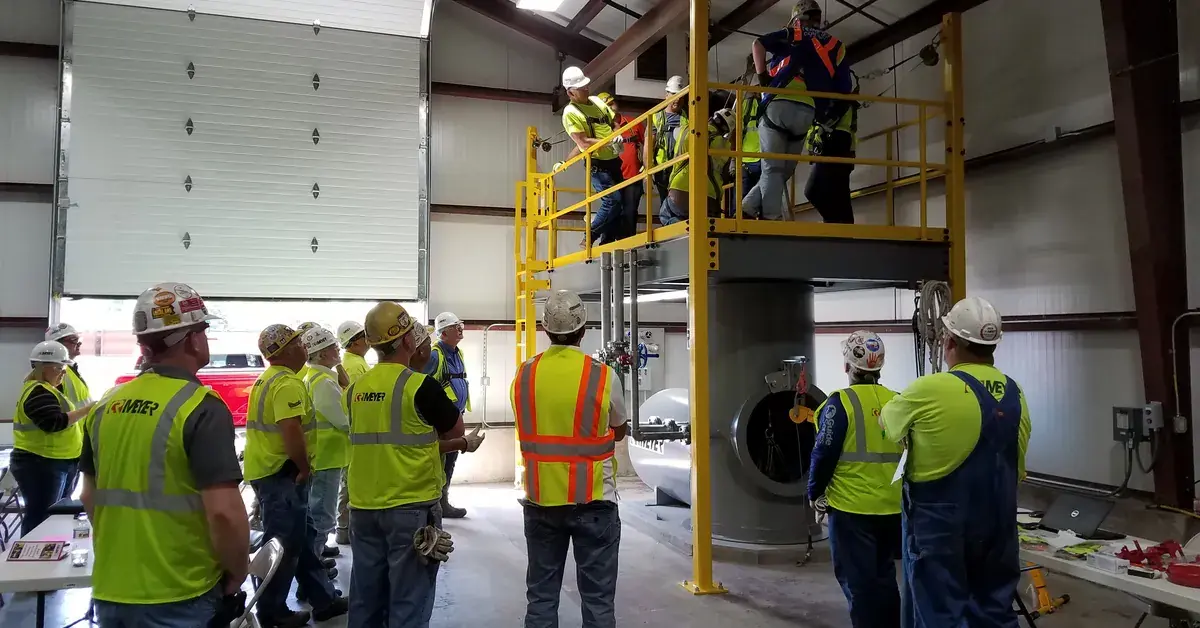
CR Meyer's answer was deliberate and resource-intensive. We stationed our corporate safety trainer on-site for four months, working 12-hour days to continuously onboard incoming workers, with training matched to the specific hazards each person would encounter in their trade and area of the site. The biggest concern wasn't the heat or the complexity; it was culture. Workers arriving from outside CR Meyer's world brought their own habits, some oriented toward speed over process. CR Meyer held the line: every procedure exists for a reason, and every worker on the site was expected to follow them.
A contract doesn't create a safety culture, it just assumes one exists. Owners should ask directly: How do you bring workers into your safety culture when they're arriving from somewhere else?
What Does Safety Culture Tell You About How a Contractor Will Handle Problems?
Every project can have incidents. The question isn't whether something will go wrong, it's what happens next.
At CR Meyer, the response protocol is clear: people first, investigation second, production third. When an incident occurs, work stops in the immediate area. The employee is cared for. The investigation begins. The owner is notified. Production resumes when it's safe to do so, not before.
That prioritization, applied consistently, is one of the most reliable indicators of how a contractor will behave when a project is under pressure. Contractors who treat production as the first priority in a crisis are the same contractors who will cut corners on coordination, communication, and accountability when schedules tighten. How a contractor responds to an incident is a window into its values under stress, and those values don't change depending on who's watching.
Why Is OSHA VPP Participation a Meaningful Signal for Owners?
For 20 consecutive years, CR Meyer has participated in OSHA's Voluntary Protection Program (VPP), a rigorous program that recognizes employers whose safety and health management systems go beyond basic compliance. VPP participation means inviting OSHA onto job sites and into interviews with employees, voluntarily.
Most contractors treat regulatory agencies as adversaries, but CR Meyer treats them as a check on its own standards. That's not a posture adopted for a review cycle; it's a reflection of how CR Meyer actually operates, on every project, in every state where it works.
What CR Meyer's Safety Numbers Mean for Your Project
In 2025, CR Meyer logged 4,124,130 man hours with a TRIR of 1.26, meaningfully below the industry benchmark of 1.6. The Lost Time Incident Rate was 0.29, less than half the industry average of 0.6.
Those numbers matter, but what they represent matters more: four months of on-site training on a single project, daily morning coordination meetings, pre-task planning on every shift (and when the task changes during the same shift), and an organizational commitment to safety that has held for more than 135 years. Safety performance at that level comes from leadership that has treated safety as a core value long enough that it stopped being a policy and became a culture.
Owners who choose contractors based on safety culture don't just get safer projects. They get more disciplined planning, more accountable crews, and a contractor whose behavior under pressure reflects the same values it presents in the bid process. That alignment, between what a contractor says and what it does, is what separates a low incident rate that means something from one that doesn't.
Talk to CR Meyer About Your Next Project
If you're evaluating contractors for a complex industrial project and want to understand how CR Meyer's safety culture translates to project execution, we'd welcome the conversation. Contact CR Meyer to get started.